Prevention

First Visits & Infant Exams

A short, unhurried first appointment for babies and toddlers, done knee-to-knee on your lap, with a full exam, a gentle cleaning, and time for your questions.

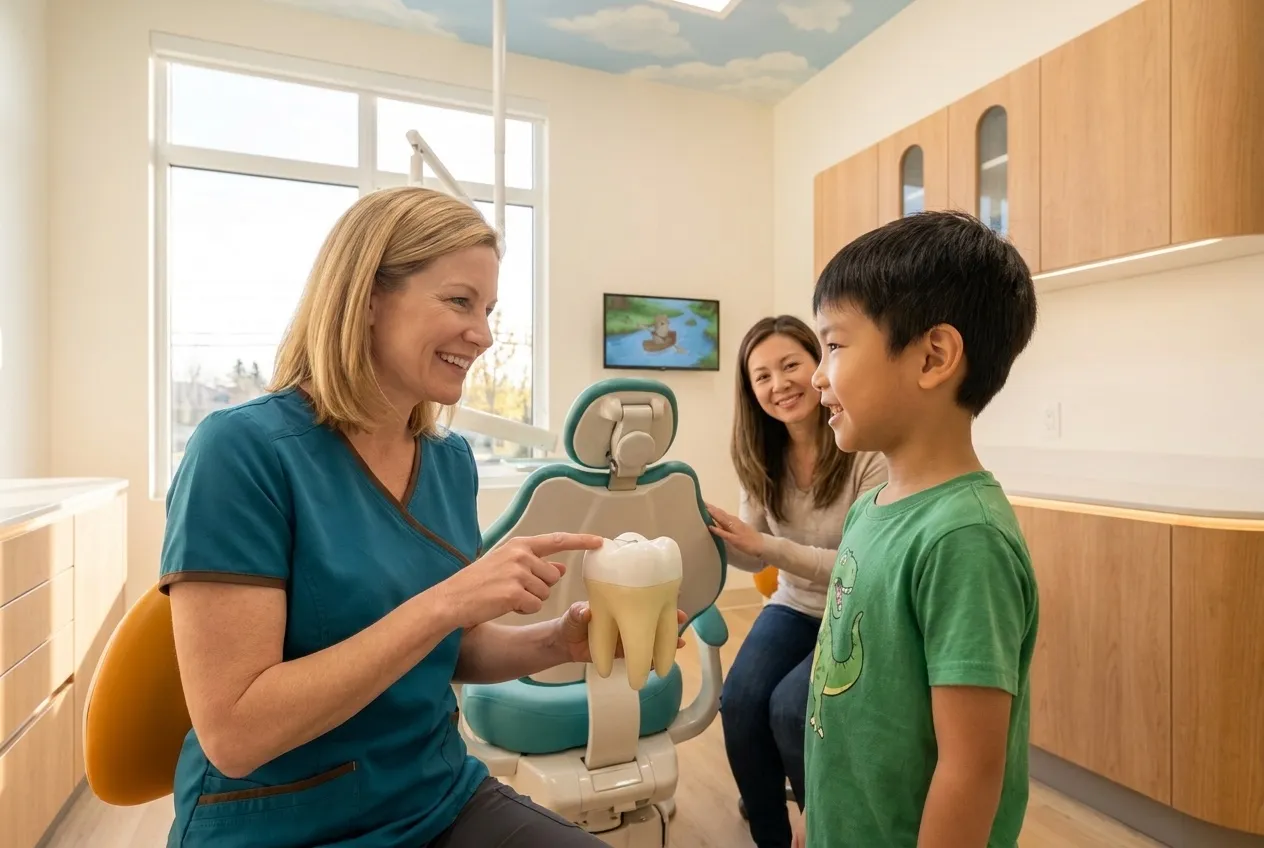
Dr. Julia Hartmann holding a large model tooth and pointing at it while a boy in a green dinosaur shirt watches, his mother seated behind him
The molar model. It comes out before anything else does.

When should my child first see a dentist?

A child should see a dentist by their first birthday, or within six months of the first tooth coming in, whichever happens first. This is the recommendation of both the American Academy of Pediatric Dentistry and the American Dental Association.

Most parents find that early. The reasoning is that decay in baby teeth moves quickly, and the window where it is still reversible is measured in months. A one-year-old visit is mostly about establishing a baseline and giving you instructions specific to the teeth your child actually has, rather than general advice from the internet.

What happens at the first visit?

The appointment runs about 40 minutes. Here is the actual order of it.

  1. Rosa checks you in and confirms your benefits, which she has already verified.
  2. You and your child go back together. There is a parent chair in every room.
  3. For children under three, we do the exam knee-to-knee: you sit facing Dr. Julia or Dr. Marco, knees touching, and your child lies back across your lap looking up at you. It takes about 90 seconds and your child can see your face the whole time.
  4. Older children sit in the chair, and we show them each instrument and say what it does before we use it. The mirror gets called a tooth mirror. The suction gets called Mr. Thirsty, which every child in America apparently already knows.
  5. A gentle polish, and fluoride varnish if you have consented to it.
  6. Ten minutes of questions. This is the part parents tell us they value most, so bring the ones you have been meaning to ask.

What if my child will not open their mouth?

Then we do not open it. We note where we got to and try a different way next time.

No child has ever been physically restrained in this office, and none will be. If your child cries, that is normal and we are not bothered by it. If your child refuses entirely, the visit still accomplished something: they came, nothing bad happened, and the next one is easier. We have had children take three visits to get to a full exam. That is a success, not a failure.

Can I stay in the room?

Yes, at any age, and you never have to ask.

The one favor we ask is that you let us do the talking during the exam. Children read the adult in the room, and well-meant reassurance like “it won’t hurt” plants the idea that it might. If we need you to hold a hand, we will say so.

What to bring

  • Your insurance card, or your CareSource or Buckeye card
  • A list of medications and any medical diagnoses
  • The name of your child’s pediatrician
  • A comfort object, if your child has one

The health history is available online and takes about six minutes. Doing it before you arrive is the single best thing you can do to make the visit go smoothly.

After the visit

You will leave with a written summary of what we found, your child’s cavity risk level, the recall interval we recommend and why, and a toothbrush. Your child will leave with a sticker from the Brave Smiles wall, which they get for showing up rather than for behaving.

Last reviewed June 2026 by Brightburrow clinical staff.

What parents said about this

  • My daughter is three and had been to another office where it did not go well at all. Dr. Julia handed her a giant plastic molar and just let her hold it. Sat there and answered questions about it for probably five minutes before anything else happened. By the time the exam started my kid was fine. I did not know an appointment could go like that.

    Meghan T.Google · May 2026

Questions about this

When should my child first see a dentist?

A child should see a dentist by their first birthday, or within six months of the first tooth coming in, whichever happens first. This is the recommendation of the American Academy of Pediatric Dentistry and the American Dental Association.

That feels early to most parents, and the first visit is genuinely short. What it buys you is a baseline: we can spot early decay while it is still reversible, check that the jaw and bite are developing normally, and give you specific instructions for the teeth your child actually has. Families who start at one tend to avoid the emergency visit at four.

What happens at my child's first dental visit?

A first visit at Brightburrow takes about 40 minutes and includes a full exam, a gentle cleaning, fluoride varnish if you consent to it, and time for your questions. For children under three, the exam is usually done knee-to-knee, with your child lying back across your lap facing you.

Nothing happens without warning. We show your child every instrument before it is used, and we say what it does in plain words. If your child is not ready for part of the visit, we skip that part and note it for next time. No child has ever been held down in this office.

Can I stay in the room with my child?

Yes. A parent or guardian is welcome in the treatment room for any appointment, at any age, and you never have to ask permission. Our operatories have a parent chair in them for exactly this reason.

The one thing we will ask is that you let us do the talking during the exam. Children take their cues from the adult in the room, and phrases meant to reassure, like “it won’t hurt” or “be brave,” introduce the idea that it might. If we need you to hold a hand or a phone, we will say so.

How much fluoride toothpaste should my child use?

Children under three should use a smear of fluoride toothpaste the size of a grain of rice. Children three and older should use a pea-sized amount. Both should be supervised, and both should spit rather than rinse afterward, because rinsing washes away the fluoride that is doing the work.

Brush twice a day, and make the second time the last thing before bed with nothing to eat or drink after. Most parents are surprised by how much that one change matters. Keep brushing for your child until they can write their name in cursive, which is a rough but reliable proxy for the fine motor control brushing requires.

Ready when you are

We answer every request by the end of the next business day.